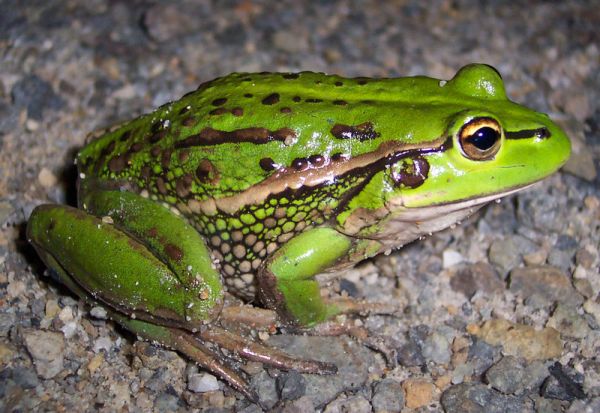
Basic Information
| Growling grass frog (Litoria raniformis) | |
|---|---|
| Description | Body bright green with golden-coloured patches on the back, and a pale stripe along the middle of the back. Back covered in wart lumps. Pads present, but only slightly wider than fingers and toes. Groin and legs with purple-pink patches. Up to 11 cm long. |
| Biology | Southern Bell Frogs1 are a semi-aquatic species found in close proximity to slow flowing creeks and water bodies. They are cannibalistic. |
| Habitat | Near water in woodland and shrubland areas. |
| Native status | Native to Australia |
| Diet | Insects |
| Distribution | South-eastern mainland Australia and Tasmania. |
| Endangered status | Vulnerable (Victoria) |
Atlas of Living Australia entry
Habitat requirements2
- Ponds or creeks with slow-flowing fresh water
- Grassy/weedy/reedy edges and vegetation patches within water
- Safe connection to Westgate Park
- Sunny areas within the waterbody
Design requirements2
- Some permanent and ephemeral freshwater
- Aquatic vegetation: low (<50cm high) vegetation around water
- Sunny road underpasses
The probability of the species persisting on sites and recolonising vacant wetlands is strongly positively related to connectivity.
Further reading
Aresco, M.J. 2005. “Mitigation Measures to Reduce Highway Mortality of Turtles and Other Herpetofauna at a North Florida Lake.” Journal of Wildlife Management 69: 689-699.
Heard, G.W., Scroggie, M., and Malone, B. 2012. “Classical Metapopulation Theory as a Useful Paradigm for the Conservation of an Endangered Amphibian.” Biological Conservation 148: 156-166.
Hale, J.M., Heard, G.W., Smith, K.L., Parris, K.M., Austin, J.J., Kearney, M., and Melville, J. 2013. “Structure and Fragmentation of Growling Grass Frog Metapopulations.” Conservation Genetics 14: 313-322.
Footnotes
-
Alternative vernacular name ↩
-
Fishermans Bend Urban Ecology Strategy Biodiversity Report (2019 ↩ ↩2