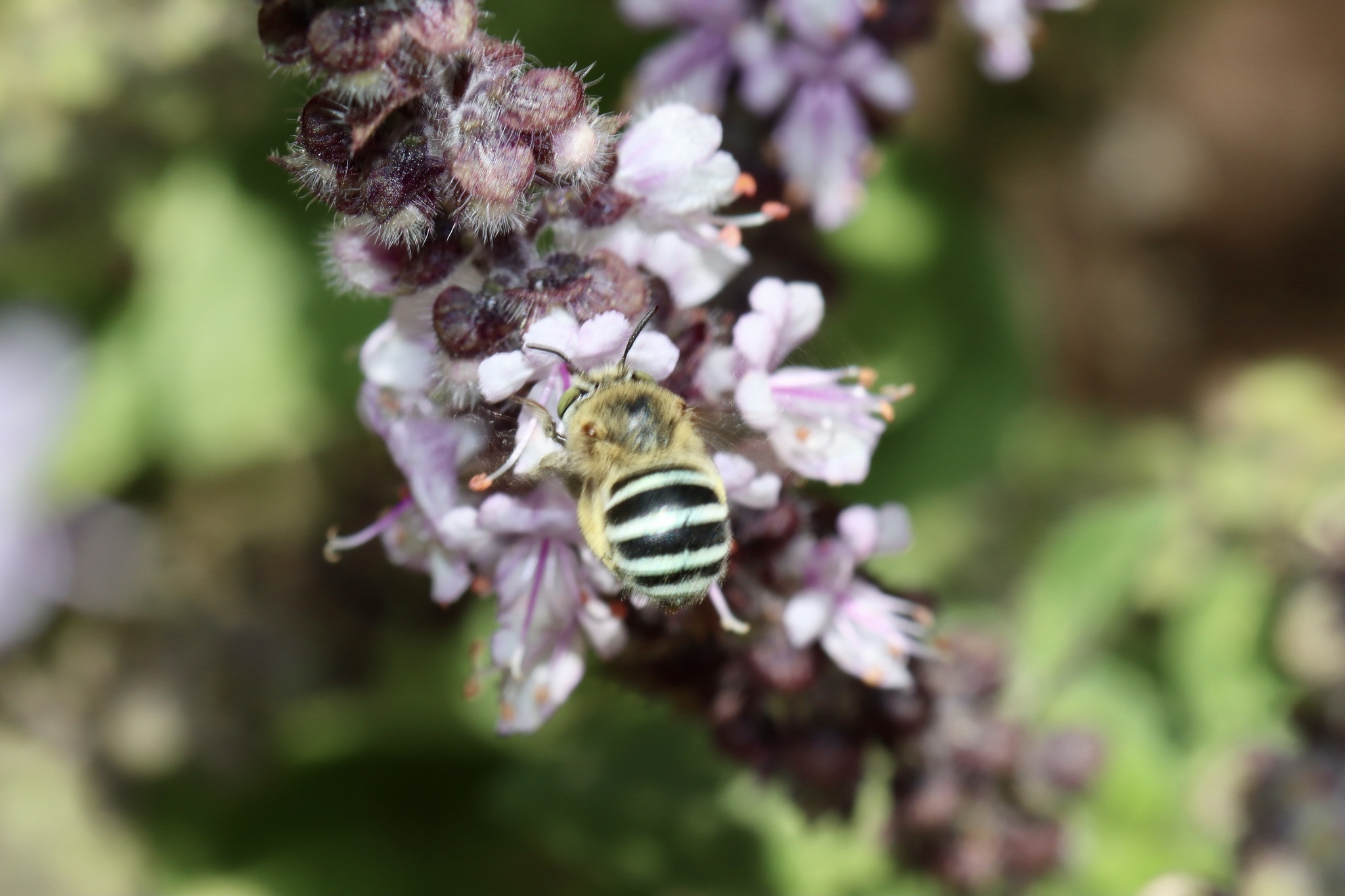
Basic Information
| Blue banded bee (Amegilla sp.)1 | |
|---|---|
| Description | Body covered in hairs. Abdomen with wide blue and black stripes. Body up to 1 cm long. |
| Biology | Blue-banded Bees live mainly solitary lives, but they nest in groups, digging many individual nest cells in the soil. The larvae are fed on liquid substances and pollen. Sleeping males can cling to grass stems or twigs with their jaws. |
| Habitat | On vegetation. |
| Native status | Native to Australia |
| Diet | Herbivore |
| Distribution | Mainland Australia |
Atlas of Living Australia entry for Amegilla genus
Habitat requirements
- Diverse mid-storey flowering plants (with some blue flowers ideally, including native Dianella sp.)
- Vegetation placed in sheltered, sunny areas
- Long-stemmed plants
- Nesting areas of soft sandstone, mud-brick or mortar.[^2]
Design requirements
Open garden beds planted with flowering plants (50-100cm height).[^2]
Footnotes
-
sp. is short for species proxima meaning “the nearest species” Fishermans Bend Urban Ecology Strategy Biodiversity Report (2019) pg. 42 ↩