Basic Information
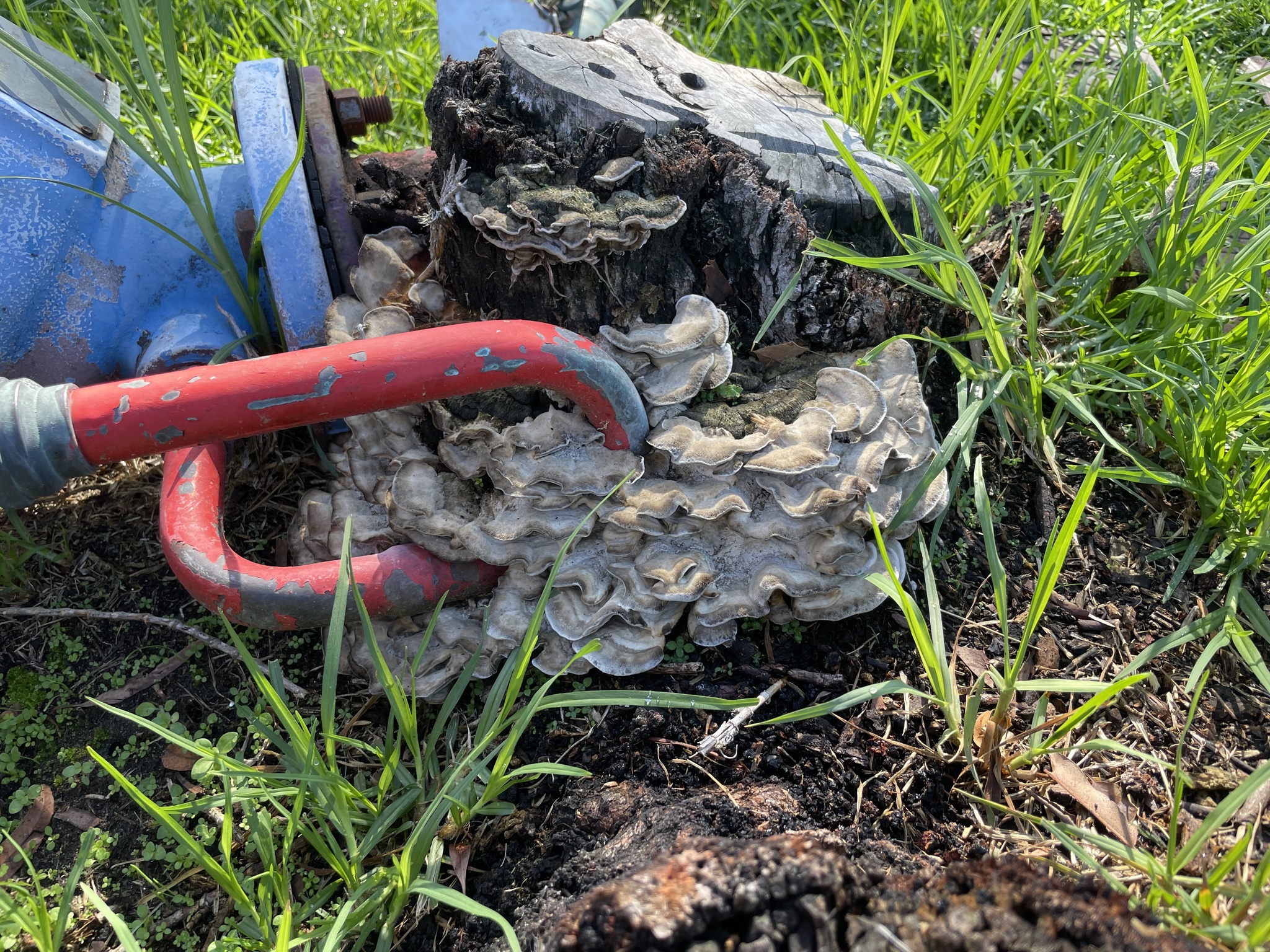
Fungi are unusual in that many species belong to the kingdom fungi but they are difficult to identify. Atlas of Living Australia has 10,953 observations of 1,140 unique species of fungi within a 10km radius of Melbourne CBD, and over 2 million observations of 14,225 unique species in Australia.1
Fungi can tolerate a range of conditions and grow in nearly all places on earth. They have mutualistic relationships with insects and symbiotic relationships plants, algae, and cyanobacteria. Some researchers have claimed the electrical signals sent between fungi qualify as language.2
Despite their small scale, they perform a range of ecosystem services. Generally, their presence suggests a healthy, functioning ecosystem.
They can be observed growing on building structures made from stone or other materials with slightly acidic pH values. Usually, growths are considered a sign of degradation and decay and removed.
This map shows observations made using iNaturalist in an area encompassing Fishermans Bend that includes 98 species of fungi. Most are in Westgate Park, but there are others along the Westgate Freeway and some of the industrial parks in the area.
Habitat requirements[^3]
- Damp soil
- Eucalyptus trees, fallen logs, dead plant matter/mulch
- Shade
Design requirements[^3]
- Contiguous soils with the ability to hold water or reliably damp patches of ground
- Eucalypts
- Capacity to tolerate/embrace leaf litter and fallen vegetation matter on the ground
Further Reading
Dighton, John. Fungi in Ecosystem Processes. 2nd ed. 2003. Reprint, Boca Raton: CRC Press, 2016. http://www.crcnetbase.com/isbn/9781482249057.
Pouliot, Alison. The Allure of Fungi. Clayton South, AU: CSIRO, 2018.
Footnotes
-
Andrew Adamatzky, “Language of Fungi Derived from Their Electrical Spiking Activity,” Royal Society Open Science 9, no. 4 (2022): 211926, https://doi.org/10/gptxb9. Fishermans Bend Urban Ecology Strategy Biodiversity Report (2019) pg. 43 ↩