Students enrolled in the Melbourne School of Design’s Master of Architecture program developed designs for a site in Fisherman’s Bend, with the goal of improving the lives of non-human stakeholders in urban environments. The subjects were a collaboration between the Melbourne School of Design (MSD) and the ADD+F Research Hub, with funding from the Creative Futures Fund and FB IDEAs.
The students developed speculative designs for novel habitats and data collection schemes.
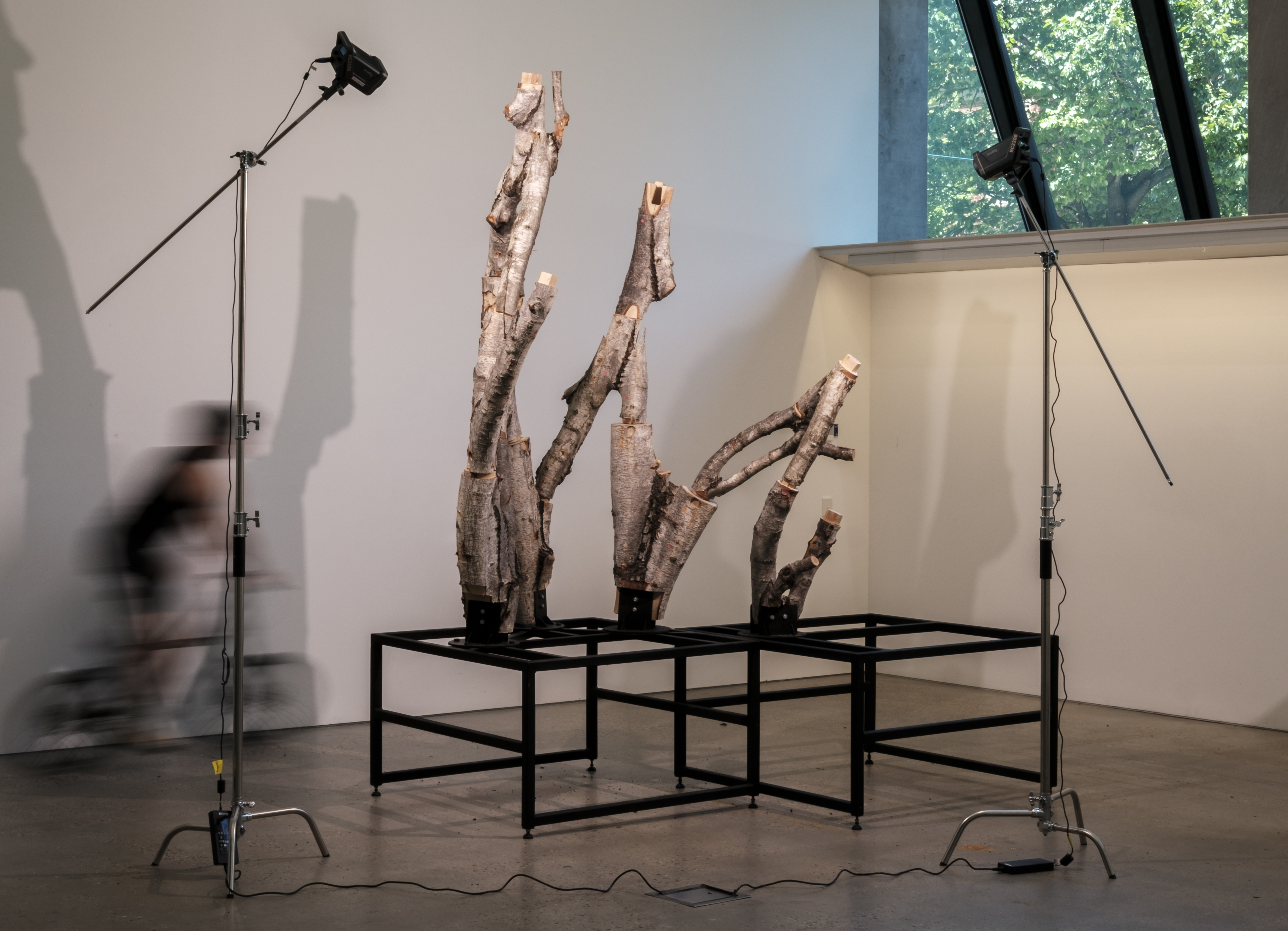
Students in DF_Lab used digital design, 3D scanning, and robotic fabrication to construct a larger structure made from reclaimed tree branches that serves as a habitat for solitary native bees.
SI_Lab students used digital design and data collection, including sound, sunlight, and temperature data, to develop a methodology for identifying locations in urban environments where more-than-humans can thrive. They used the Superb fairy-wren, a native bird found in Fishermans Bend, as a test case.
At key points during the semester, the groups met to investigate whether their developing methodologies could be mutually supportive.
Design intention
The proposals aim to provide refuge for non-humans inhabiting urban environments, which generally provide few habitat opportunities. In the case of Fishermans’ Bend, industrial zoning, poor habitat connectivity, limited green space, heavy traffic, and pollution present complex challenges to non-human life.
In such environments, novel designs that can support animals and plants are needed. These efforts broadly align with the goals of the Fishermans Bend Urban Ecology Strategy, which highlights novel artificial habits as a potential solution for Fishermans Bend.
While there are plans for large-scale green corridors in Fishermans Bend, such solutions take several years to complete. In the interim, standalone structures like artificial trees or insect hotels can provide modest habitat analogues at low cost.
The field of design that focuses on these habitats is relatively young and few established methods exist. As such, the teaching team and students imagine these proposals as “design experiments” that generate useful data, which can inform refinements to the prototypes in response to stakeholder feedback.
Subject activities
DF_Lab developed designs for perching spots for birds in Fishermans Bend, utilising novel fabrication methods for milling fallen tree branches.
SI_Lab investigated ways of collecting and interpreting data that could support the design, siting, and monitoring of non-human habitats in Fishermans Bend and other challenging urban sites.
In Week 14, students presented their work to a panel of guests from the MSD, ADD+F and FB IDEAs.
Credits
DF_Lab
Stella Gorman, Matthew Park, Andrew Wilson
SI_Lab
Cuihu Deng, Douglas Thinwa, Hengjia Hu, Taoyuan Zhu
MSD
A/Prof Rochus Hinkel, Michael Park, Tony Yu, William Ward, Prof Dan Hill, Dr Stanislav Roudavski, Prof Alex Felson